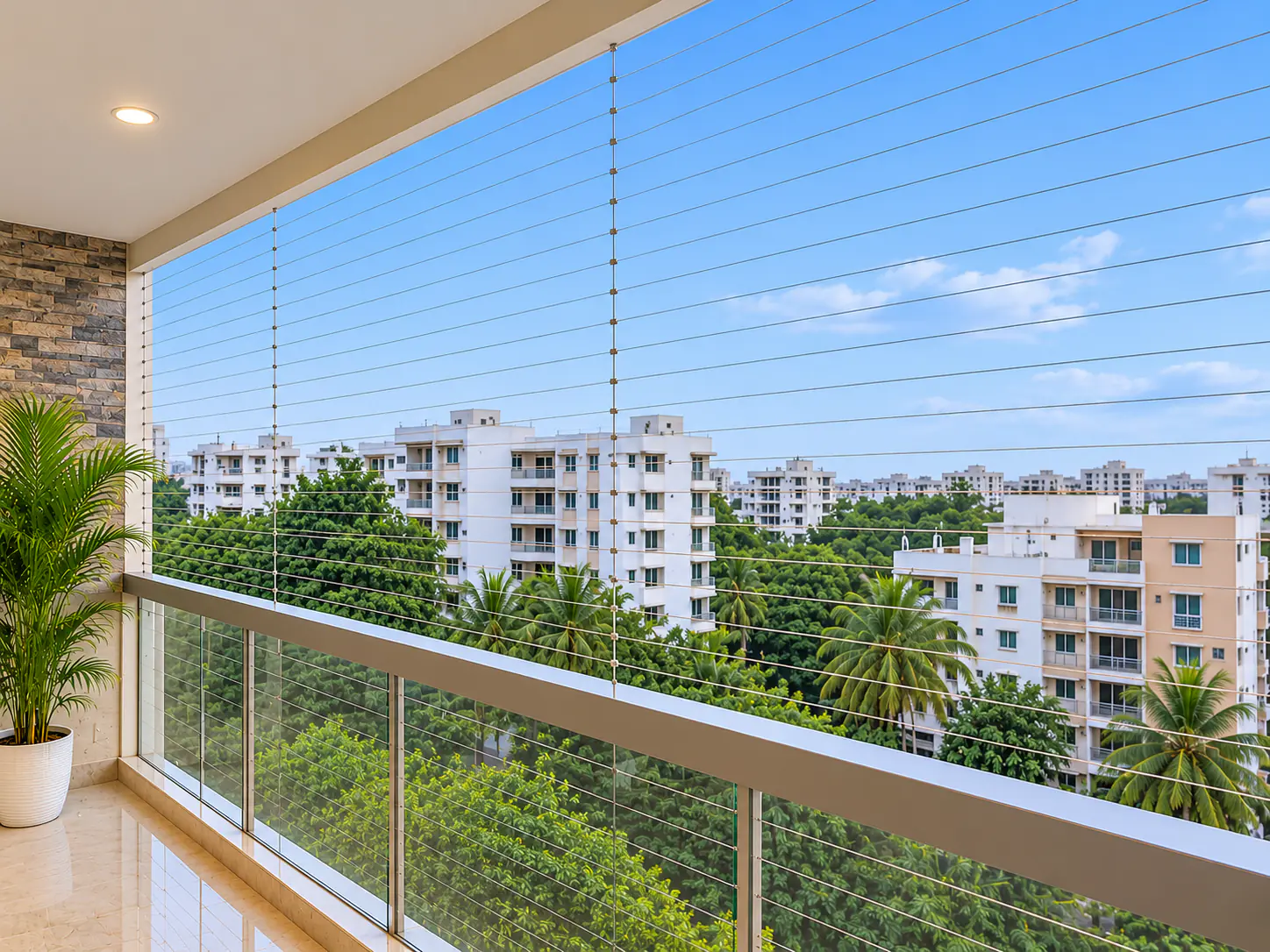
Invisible Grills at a glance
- What it is
- An invisible grill is a set of vertical (sometimes horizontal) stainless-steel cables, each tensioned between aluminium or steel tracks fixed to the floor or parapet and to the ceiling or lintel. The cables are thin enough to fade from view, while the spacing between them is kept small enough that a child cannot pass through.
- Where
- Installed for homes in Bangalore and five Odisha cities: Bhubaneswar, Cuttack, Jajpur, Puri and Brahmapur (Berhampur).
- Price
- Priced by the area covered (per square foot); quoted in writing after a site measurement.
- How to book
- Call or WhatsApp +91 89512 58886, or request a quote online. The site visit is free.
What are invisible grills?
Invisible grills are a modern replacement for the heavy MS (mild steel) box grill. Instead of bars and frames, they use slim stainless-steel wire ropes that run in parallel lines across an opening. Each cable sits in a top and bottom track and is tightened until it is taut, so it resists being pushed apart.
Because the cables are only a few millimetres thick, the eye skips over them. From inside the room you see the skyline, not a cage; from the street the building keeps its original elevation — something many apartment associations care about.
How invisible grills work
The strength of an invisible grill comes from three things working together: the tension in each cable, the gap between cables, and how firmly the tracks are anchored into concrete. A well-fitted system behaves like a taut instrument string — press one cable and it flexes slightly, then springs back.
Tracks
Aluminium or steel channels are fixed at the top and bottom of the opening (or at the sides for horizontal runs). These hold the cable ends and spread the load into the structure.
Cables
Stainless-steel wire rope is threaded through the tracks at a fixed spacing and tensioned one cable at a time, so every line is equally tight.
Anchoring
Fasteners go into solid RCC — the slab, beam or parapet — rather than plaster or tile alone. Where a surface is weak, we tell you before fitting, not after.
Where invisible grills are installed
Most homes start with the balcony and then add windows. We fit invisible grills on open balconies, utility balconies, sit-outs, bedroom and living-room windows, French windows, staircase openings and duplex double-height voids.
- Apartment and high-rise balconies
- Sliding and casement windows
- French windows and full-height glazing
- Staircase landings and internal voids
- Villa and independent-house terraces
Benefits of invisible grills over traditional grills
A box grill makes a balcony feel smaller, collects dust on every bar and eventually needs scraping and repainting. Invisible grills avoid most of that. They also make it easier for a parent to watch a child playing outside, because nothing blocks the line of sight.
For families, the deciding factor is usually peace of mind: once the opening is closed with correctly spaced cables, the balcony becomes a room you no longer have to lock.
Cable and material options
Invisible grill cables are generally made from stainless steel, commonly in grades such as SS 304 or SS 316, with a nylon or similar coating on some cable types. Tracks are usually aluminium. The cable grade, thickness, coating and spacing used on your job are written into our quotation so you know exactly what you are paying for — we do not quote one material and fit another.
Coastal homes, such as those in Puri, face salt-laden air, so we discuss material choice for exposure during the site visit.
Maintenance and durability
Day-to-day care is simple: wipe the cables with a damp cloth when you clean the balcony and keep the bottom track free of soil from planters. Have the tension checked if a cable ever feels slack, and avoid hanging heavy items from the cables — they are a safety barrier, not a clothes line. If you need drying space, a ceiling cloth hanger pairs well with invisible grills.